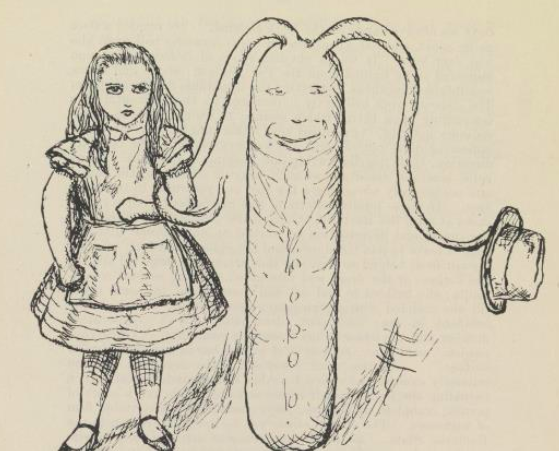
For those of you who don’t know me, I am obsessed with Alice in Wonderland. I am talking obsessed – I have trinkets of Alice, I freaked out when I met Alice in Disney World, heck I took my nickname Kat after the Cheshire Cat. Lewis Carroll did more than just write a book for his daughter (and possibly give children nightmares of the Queen of Hearts); he opened my eyes to exploring the unknown. I always had an itch for learning about the mechanisms of the world and why I behave the way I do. I was hungry to try the unmarked and unnamed foot palate that was my scientific knowledge and even crazier to know why the Mad Hatter behaved the way he did and how a rabbit could talk (and if I could get both of them to come to my 6th birthday party). Alice in Wonderland, though just a mere children’s book, did so much more to expand my curiosity than I could have ever asked for.
I never knew a part of my life that wasn’t involved in the sciences. My earliest memories of science were when I was about 4 or 5. That being said I had big dreams back in the day that was influenced by my grandparents and my father. My grandpa was an orthopedic surgeon who would talk to me about his residency and the types of surgeries he would do, my grandmother was an ER nurse who loved telling me the ghastly details of trauma in the ER and finally, I had my father who is a petroleum engineer and would show me cool science videos and engineering things he would do. I also grew up in Houston, Texas, which was a hub for science. So I was on the bandwagon with all the other Texas kids of becoming an astronaut and working for NASA one day. Eventually, all of these exposures morphed into one giant passion and I remember telling my parents and kindergarten teacher I wanted to be the first astronaut who was a bone doctor and could study the stars. I would go around learning the constellations and started learning the human body because I was just so intrigued.
However, while my grandfather and my dad influenced my love for the body and engineering, my grandmother was the one who turned me on to actually studying science as a college student. My grandmother Sandy was not only incredibly intelligent, but also emotionally intelligent. She could read a person and their character without even talking to them (which meant I got into a lot more trouble than I should have with my grandparents). She was so intuitive with the human body and a person’s character that her knowledge sometimes surpassed my own grandfather’s (the orthopedic surgeon). She taught me how as a nurse she needed to know patients on a different plane than as a doctor and how she needed to both understand the physical body but also the mind. She talked often about her experiences and showed me how passionate she was about her job. My grandmother was the one who helped me fall in love with biochemistry because of the vast complexities that biochemistry can describe. She taught me to develop a deeper understanding of the brain-body duality and understand that to be a good student you have to acknowledge the physical as well as the internal aspects. With biochemistry, I could not only understand the biological impacts but also the chemical impacts that something has on a human body.
Eventually, my childhood dreams of working for NASA passed and I wanted to follow in my grandfather’s footsteps and become a doctor; specifically a psychiatrist. I wanted to understand the brains of patients but also wanted to treat their diseases. I wanted to understand the drugs that helped the body and the mind. My grandparents encouraged me to go to Muhlenberg because of their strong science majors (Also my grandpa is an alum… go Mules!) and recommended biochemistry and psychology to fulfill my goals. My grandmother, in particular, saw my skills in biology and chemistry and my natural love of science that she said having these majors would be a perfect combination for me to study medicine. I come to find out it is almost impossible to be a psychology and biochemistry double major so I ultimately decided to study biochemistry because I wanted the chemistry knowledge and wanted the experimental background.
My love for biochemistry comes from my own interest in it but my grandmother helped push me to find my love in it. She really opened my eyes to so much about drugs, my body and just following my interests. While my dreams of becoming a psychiatrist are gone (explained later), I still have the same passion for drugs and the mind. Another thing my grandmother helped me fall in love with was my love for reading; especially Alice in Wonderland. I have shaped my life so closely around that book; meaning, I am either bonkers or just passionate. It all came back to the childhood questions of wanting to understand why the Mad Hatter was mad?, what Alice was drinking?, How could she shrink?, Could this even be possible in real life?, What drugs was she taking? Alice in Wonderland shaped my love for sciences in a unique way because I wanted to understand the craziness of life. I wanted to understand the peculiarities in life. My favorite quote ever is “curiouser and curiouser” because I am always curious about something and always have that insanity to learn something new.
Coming back to Biochemistry, throughout my whole life, I would always ask “why this happens” or “how does this occur.” I kept going in science because I genuinely was in love with knowledge behind it and because I can get the how and why answers I have asked. I chose biochemistry because it gave me the biological reasoning on how things worked the way they worked. It was just the right blend of biology and chemistry that made me fit through the door (just like in Alice). I keep going into science because I not only love it but I need to know how things work. I wanted to know why humans were the way they were and what made us good, evil and mediocre. I also wanted to understand why humans think so differently and why people are so unique compared to myself. I wanted the big picture and my hunger was only satiated through studying both biology and chemistry, or the chemical mechanisms behind the biological processes. I could ask the craziest questions on how life works and have them probably answered through biochemistry without a thought. I could ask questions on how drugs worked and how they affect the body/mind. I want the mechanism behind the madness, like from Alice in Wonderland.
As of right now, I want to go to pharmacy school and eventually go for my residency in immunotherapy. This is a fairly new aspiration of mine but I am willing to do anything I can to stick with it. My first 2 years at Muhlenberg were rough. I struggled with grades and my health. I would constantly be getting sick and then when I was healthy I was so tired that I would be falling asleep in class. I went from high school where I was at the top of my class and getting all of these general concepts to struggling to keep up with the homework and barely passing my exams. It was so frustrating and hard for me to comprehend what was going on. I would get so stressed and spend hours studying when I would make the same grades if not worse. I didn’t have the support system I needed and I was drowning in my own anxiety and fears. I finally declared biochemistry and was told I wouldn’t last. I wasn’t smart enough, I didn’t have the skill (again), I was lazy and that I would just be a perpetual failure. When I finally got diagnosed with an autoimmune disorder, it was disappointing and scary, but also a relief. I went from being a lazy student to actually having a disease that impacts the way I study and my health so drastically. I started treatment ASAP and my grades skyrocketed after that.
Because of this weak start, I felt I was at a disadvantage to my scientific peers. Instead of attacking scientific jobs and pursuing research through the traditional route that most science students take at Muhlenberg, I turned to other majors of interest and back into the Allentown community. I picked up psychology research on phonological swear word form preparation in Dr. Frazer’s lab. Dr. Frazer has been a fantastic mentor to me because she has helped me find my footing on how to be a researcher and how to make educated guesses in the lab. She also gave me more of an interest in studying participants and how people react to things instead of just the microscopic level that I was used to studying. She pushed me to look at the bigger picture instead of just focusing on the tiny details that go into an experiment. I fell in love with patient care because of her mentoring. Because of her research lab, I was introduced to Dr. Rudski, who has a background in psychopharmacology and drug therapy in patients. I have been fortunate enough to take a few classes with him including a private research class looking into how opioids are impacting the Allentown community and what opioids do to the brain. With Dr. Rudski’s research method I was able to broaden my interests into the biochemistry behind drugs and why drugs are crucial in certain populations. I started to mold my interest in psychopharmacology but also got back to the original model of why I love science. I fell back in love with my passion when I felt I was thrown out of it.
With all this being said this goes back into why I want to do pharmacy and immunotherapy/psychopharmacology drug research. I love chemistry and biochemistry, I understand the effects certain drugs have on your body personally and I want to make a difference. Certain medications are horrible on the body; meaning I could have severe side effects or develop a flare-up with the medications not doing their job. I want to help people live healthier, stable, and happy lives with autoimmune disorders or certain types of cancer. I want to at least help with drug research and finding drugs that have limited side effects, are minimally invasive, and are incredibly effective in treating the disease, which immunotherapy is a good alternative for. I also want to understand how the brain is impacted by autoimmune disorders. Like for example, Hashimoto’s disease makes a person incredibly tired and fatigued. How is this fatigue impacting their studies or their work? How can we help a person stay mentally cleared and focused? Once again, speaking from personal experience, I know that drugs can clear your head drastically. What medications can I take that will help me keep my mental clarity and focus as it has been? I really hope I can get to this point, and I am going to do everything in my path to get there.
I just want to at least say one day I tried to make a difference.