
There are currently several mutations in patients with SLE. The immune response as a whole is impacted with this disease. To start off with the normal function of the immune system in a healthy patient, it is first important to discuss the function of Toll-like receptors (specifically TLR7 and TLR9) and how they play a role in normal immune system function. Toll-like receptors are a class of proteins that are single-pass membrane spanning receptors and expressed on macrophages and dendritic cells, that recognize structurally conserved molecules. They are also a type of pattern recognition receptors (PRR). It is a defense system that activates immune cell responses and specific receptors once an antigen has been detected. In healthy people, TLRs are able to bind to ligands and are able to properly recruit adapter proteins like Myd88 within the cytosol of the immune cell in order to propagate the antigen-induced signal transduction pathway. These recruited proteins are then responsible for the activation of other downstream proteins like protein kinases that further amplify the signal and ultimately lead to the upregulation and suppression of genes that prompt the inflammatory response and other transcription events that could cause inflammation. TLRs are also used in the production of cytokines, proliferation and survival.
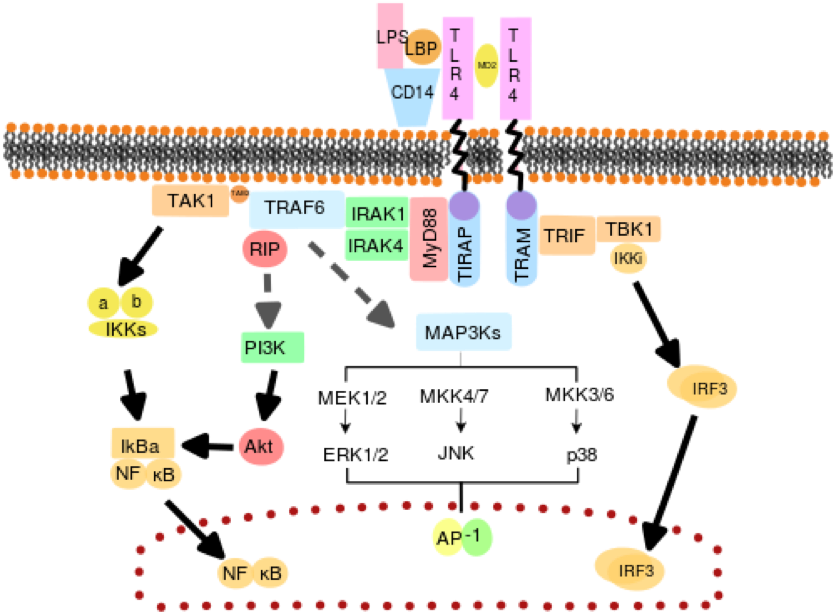
The pathway above describes the normal, healthy signaling pathway of TLRs. In this pathway, TLR4 recognizes LPS and CD14 and LPS-binding protein help bind LPS to TLR4. Once this binding occurs, TRAM TIRAP are recruited and form either the Myd88 dependent pathway or TRIF dependent pathway. In SLE patients, Myd88 is altered so we will focus on this dependent pathway. The Myd88-dependent response occurs on dimerization of the TLR receptor (including TLR7 and TLR9). Ligand binding and conformational change that occurs in the receptor recruits the adaptor protein Myd88. Once this happens, IRAK1 and IRAK4 are recruited. IRAK kinases are then phosphorylated and activate the protein TRAF6, which then polyubiquinates the protein TAK1. TAK1 then binds to IKK-beta and phosphorylates and then phosphorylates Ikb causing degradation and allowing for NFkB to diffuse into the cell nucleus. This activates transcription and halts the induction of inflammatory cytokines. TLRs help create this anti-inflammatory response and allows for the body to respond to foreign pathogens in a healthy way instead of leading to a flux and cyclic pattern in overactivation of inflammatory responses.
With TLRs, there are specific receptors that are specifically impacted in SLE, TLR7 and TLR9. TLR7 and TLR9 are used in pathogen recognition and detect single stranded RNA. These toll-receptors are used in the detection of pathogens by the innate immune system. In healthy people, the innate immune system has three main strategies that allow for the avoidance of self-cell destruction. TLR7 specifically recognizes pathogen-associated molecular patterns (PAMPs) that are expressed on infectious agents and mediate the production of cytokines necessary for the development of effective immunity. Specifically, in SLE, TLR7 has a receptor TREML4 that acts as an essential positive regulator of TLR7 signaling. In lupus patients, TREML4 can be mutated to either not be produced properly which ultimately leads to the impaired phosphorylation of the transcription factor of STAT1. STAT1 is important because it is involved in upregulating genes and promoting healthy apoptosis and cell proliferation.
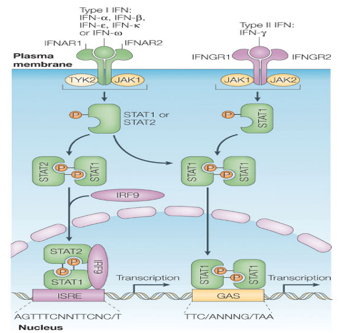
The JAK-STAT1 pathway above describes how IFN recruitment leads to JAK recruitment to the plasma membrane. This results in STAT1 recruitment and through phosphorylation recruits IRF9 and eventually leads to transcription. This pathway with the use of JAK activation stimulates cell proliferation and is critical in the development of a healthy immune response. If there are mutations involved in this pathway, like any in TLR7 in patients with SLE, there can be an impaired response that leads to a failure to regulate JAK signaling properly that causes chronic inflammatory disease.
In TLR9, it is a protein that is expressed in immune system cells including DCs, macrophages and other antigen presenting cells (APCs). In humans, TLR9 is encoded by the TLR9 gene and is designated as CD289. TLR9 functions in healthy APCs by binding to DNA present in foreign antigens and triggers signaling cascades that lead to a pro-inflammatory cytokine response. TLR9 is unique in that it is expressed in immune cell rich tissues, such as the spleen, lymph nodes and bone marrow. TLR9 is usually activated by unmethylated CpG sequences in DNA molecules. CpG oligodeoxynucleotides are short single stranded synthetic DNA molecules that act as immunostimulants when they are left unmethylated. Once it is activated, TLR9 moves from the endoplasmic reticulum to the Golgi apparatus and lysosomes, where it interacts with Myd88. TLR9 is then cleaved in healthy patients. This cleavage is done to prevent whole protein expression on the cell surface, which could lead to autoimmune antibody production and autoimmune disorders. TLR9 is expressed intracellularly and functions to alert the immune system of viral and bacterial infections by binding to DNA rich in CpG motifs. This signal leads to activation of the cells and results in initiating pro-inflammatory reactions that result in the production of cytokines such as type-I interferon, IL-6, TNF and IL-12. What makes TLR9 unique in SLE patients is that it is impacted by the virus EB. EBV decreases the expression of TLR9 in B cells which diminishes the production of TNF and IL-6. It is also researched that EBV alters and causes atomic mutations that alter expression of TLR9 at the transcriptional, translational and protein level. In healthy patients, there is no lack of TLR9 expression and there is a strong regulation of chronic autoimmune inflammation.
Another normal function gene in humans is the myeloid differentiation primary response 88 (Myd88) protein. Myd88 is a universal adaptor protein that is used in both TLR7 and TLR9 to activate the transcription factor NF-kB, a protein that controls the transcription of DNA, cytokine production and cell survival. The Myd88 protein allows for signals to be relayed inside and outside of the cell and helps reduce any potential confusion in the innate immune system in attacking itself. In healthy humans, Myd88 properly fights off viral infections like EBV and can regulate and control/limit the amount of mutations that are a result from diseases like this. As seen in the first figure above, TLR regulate the Myd88 dependent pathway and help produce NFkB.
Finally, it is important to recognize that lack of formation of autonucleic antibodies in healthy patients prevents the development of almost ANY autoimmune disorder, including lupus. Autoantibodies are formed through B cell production and can occur randomly or in response to a foreign protein. However, due to mutations that occur in patients with SLE, the host cannot recognize and differentiate the body’s own cells from pathogenic cells. In healthy people, autoantibody production is regulated through clonal deletion of any unused B or T cells.
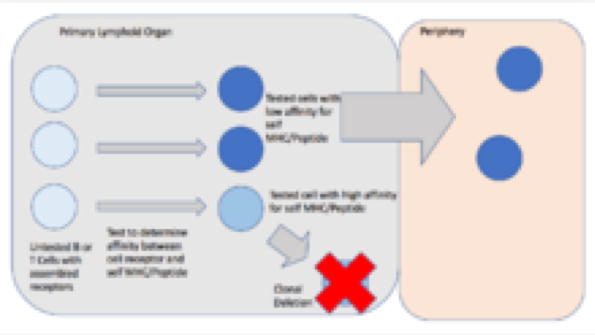
As seen in the picture above, it is showing how in primary lymphoid organs, autoreactive cells are terminated before maturation in order to prevent further proliferation. B and T cells are presented with self-antigen after developing receptors while still in primary lymphoid organs. Those cells that demonstrate a high affinity for this self-antigen are often subsequently deleted so they cannot create progeny, which helps protect the host against autoimmunity. In the process of clonal deletion, a lymphocyte would receive apoptotic signals from APCs. In healthy people, incomplete clonal deletion occurs where most autoreactive B and T lymphocytes are killed off. In patients with autoimmune disorders like HIV, complete clonal deletion occurs where all autoreactive cells are killed off. This can lead to molecular mimicry and can cause a surge in infections in the host.
